
Social Media Screening. Social Media Checks. Online Checks. Social Media Vetting. Adverse Media Screening.
If you work in HR, recruitment, safeguarding, or compliance, you have probably encountered several of these terms. The challenge is understanding whether they describe different background checks, or simply different names for broadly the same process.
In many cases, the terminology overlaps.
Across the employment screening industry, terms such as Social Media Screening, Social Media Checks, Social Media Background Checks, Social Media Background Screening, Social Media Vetting, and Online Checks are often used interchangeably.
There can, however, be differences in scope between providers. Adverse Media Screening, for example, will typically focus more specifically on negative news, media reports, and other publicly available sources, rather than somebody’s wider social media activity.
What matters more than the name is what is actually being searched, why the check is being conducted, how the information is reviewed, and how the results are used.
For employers, the objective should be straightforward: to assess relevant, publicly available online information as one proportionate part of a wider recruitment process.
This guide explains the terminology, how Social Media Screening works, what employers can and cannot see, and how these checks fit alongside established screening such as DBS checks.
What is Social Media Screening?
Social Media Screening is the process of reviewing publicly available online information about a candidate or employee to identify relevant behavioural, safeguarding, or reputational concerns.
It is usually carried out as part of pre-employment screening alongside checks such as identity verification, Right to Work, criminal record checks, employment references, and employment history verification.
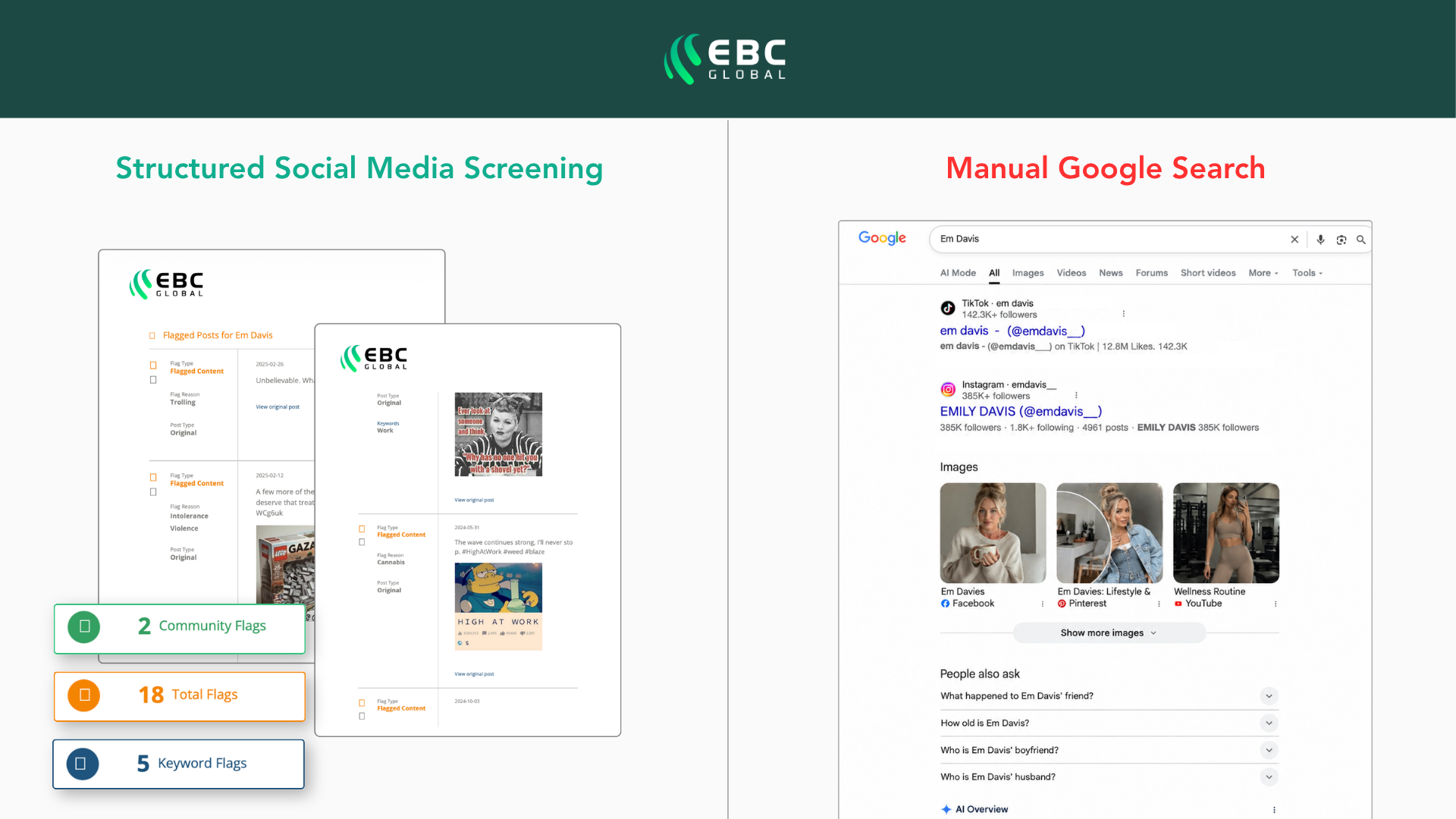
Unlike somebody manually typing a candidate’s name into Google or scrolling through a social media profile, professional social media background screening provides a more structured approach.
Technology can help locate relevant public profiles, process significant volumes of publicly available content, and identify information falling within predefined screening categories. Results can then be reviewed within an established process rather than leaving individual recruiters to decide independently what they consider appropriate or inappropriate.
EBC Global’s Social Media Screening solution, for example, searches across more than 10,000 publicly available online sources and social platforms. Screening can consider written and re-shared content, videos, images, comments and interactions, and publicly visible group memberships or follows.
The important word throughout that description is publicly.
A Social Media Check is not permission for an employer to investigate every aspect of someone’s personal life. Screening should have a defined purpose, be relevant to the role and identified risks, and be carried out fairly, transparently, and proportionately.
Related reading: Social Media Checks for Safer Recruitment
What are Social Media Checks?
A Social Media Check is another commonly used name for Social Media Screening.
You may encounter all of the following when comparing employment screening providers:
| Term | What it generally means |
|---|---|
| Social Media Screening | Structured screening of relevant, publicly available social media and online information |
| Social Media Checks | Common alternative term for Social Media Screening |
| Social Media Background Checks | Social media screening conducted as part of a wider background checking process |
| Social Media Background Screening | Another term for screening online activity during recruitment |
| Social Media Vetting | Often used in safeguarding, security, and higher-trust recruitment environments |
| Online Checks | A broader term that can include search engines and other publicly available online sources |
| Adverse Media Screening | Usually more focused on negative news, media coverage, and other adverse publicly available information |
The distinction is therefore often about scope rather than an entirely different type of check.
For example, an adverse media check might identify credible news coverage connecting an individual to fraud or misconduct. A wider Social Media Check could consider publicly available social posts, comments, images, videos, interactions, and other online activity against predefined screening categories.
This is why organisations comparing a social media screening company should look beyond the product name and ask what the check actually covers.
How Do Social Media Checks Work?
So, how do social media checks work in practice?
The exact process varies between screening providers, but professional screening should be considerably more structured than an HR manager conducting an informal internet search.
1. Relevant public profiles are identified
The first challenge is correctly identifying online information connected with the candidate.
This matters because names are rarely unique, usernames can differ between platforms, and incorrect identification could result in information being attributed to the wrong person.
2. Publicly available information is analysed
Professional screening technology can process large volumes of publicly accessible online information against defined screening categories.
EBC Global’s solution searches across 10,000+ publicly available online sources and social platforms, analysing areas including written content, re-shared content, images, videos, comments, interactions, and other publicly visible activity.
3. Potentially relevant information is flagged
Technology can help identify potential indicators requiring further consideration.
This is different from allowing an algorithm to make the hiring decision.
A flagged result needs context. A person quoting offensive language to condemn it, for example, is very different from somebody endorsing that language.
4. Results can be reviewed
Human oversight is important.
A professional social media background check should provide information that authorised recruitment, compliance, or safeguarding teams can assess against their policies, rather than producing an automatic verdict about whether somebody should be hired.
5. Decisions remain role relevant and proportionate
Employers should have a clear reason for conducting the check and consider only information relevant to the recruitment decision.
This helps create greater consistency and fairness while reducing the subjectivity associated with informal searches.
6. An audit trail is maintained
Structured screening also creates a clearer record of what was checked and how relevant results were handled.
For compliance-driven organisations, this can be significantly more useful than individual recruiters carrying out undocumented searches themselves.
What Do Social Media Checks Look For?
One of the most common questions from employers is: what do social media checks look for?
The answer depends on the screening policy, provider, sector, and role.
Potential categories can include publicly available content indicating:
- violence or threatening behaviour,
- harassment or bullying,
- hate speech,
- discriminatory behaviour,
- illegal activity,
- online abuse or trolling,
- safeguarding concerns,
- inappropriate conduct relevant to the role, and
- serious reputational concerns.
Screening can also provide context beyond negative findings. EBC Global’s reporting, for example, may identify positive indicators such as volunteering, community involvement, charity participation, professional engagement, and positive advocacy.
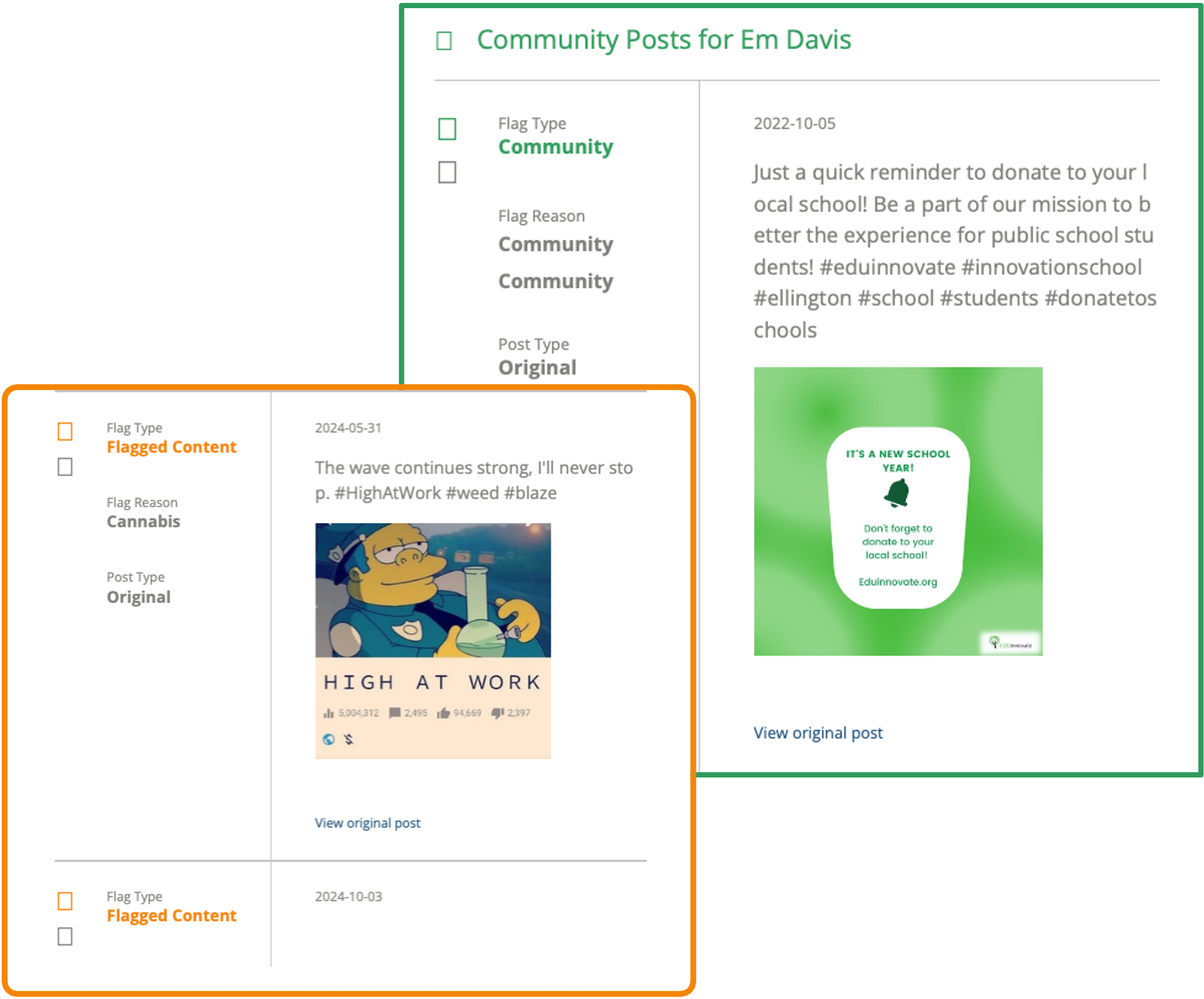
The purpose is not to establish whether an employer agrees with everything a candidate has ever said online. Employers should be particularly careful not to make recruitment decisions because they have discovered protected or irrelevant personal information. Screening should focus on clearly defined risks connected with the role.
A sensible question is therefore not simply, “What did this person post?“
It is, “Is this information relevant to an identified risk associated with this role, and is it appropriate and lawful for us to consider it?“
That distinction is central to fair Social Media Screening.
Why Do Employers Carry Out Social Media Screening?
So, why do employers check social media when they already conduct conventional background checks?
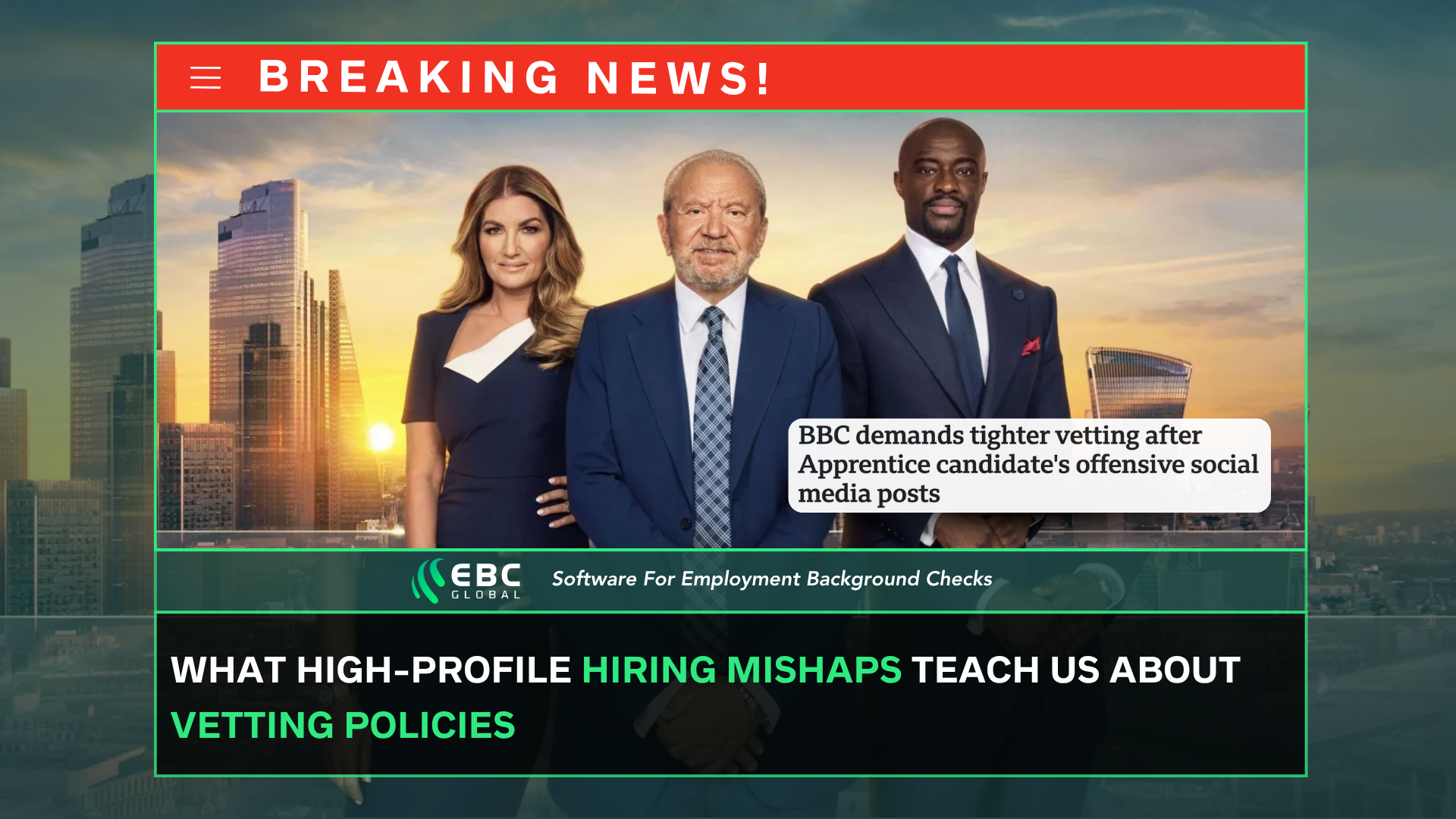
Recent high-profile cases, including The Apprentice, have shown how historic online activity can resurface and create reputational concerns for both individuals and the organisations associated with them.
Different checks provide different insights. A DBS check may provide relevant criminal record information, identity checks help confirm who somebody is, and employment verification can confirm their work history. Social Media Screening adds another layer by considering relevant behaviour or activity that a candidate has made publicly available online.
Organisations may introduce social media screening for employment to support safeguarding, manage reputational risk, and strengthen recruitment for positions of trust. This can be particularly relevant where employees work with children or vulnerable adults, handle sensitive information, or represent an organisation publicly.
No single background check provides a complete picture. Used proportionately, Social Media Screening can complement other employment checks and help organisations make more informed, consistent recruitment decisions.
Related Reading: Why a Social Media Check Is Essential for Your Hiring Process
Can Employers See Private Social Media?
No. Professional Social Media Screening should focus on publicly available information.
Employers should not need a candidate’s social media password, ask them to change privacy settings, create fake accounts to gain access, or otherwise circumvent privacy controls.
If content is restricted to approved friends or followers, it should not become accessible simply because an employer decides to conduct a Social Media Check.
This distinction is important under UK data protection law.
The fact that information is publicly accessible does not mean employers can automatically collect and use it without considering their data protection obligations.

The Information Commissioner’s Office (ICO) advises that organisations wanting to use public social media profiles for pre-employment vetting must be able to justify why doing so is necessary, identify and document the specific risk, conduct the process fairly, and inform candidates that social media will be checked.
Employers should therefore build Social Media Screening into a transparent recruitment policy rather than conducting secret or informal searches.
Social Media Checks vs DBS Checks
Does a DBS check social media? No.
A Disclosure and Barring Service check and a Social Media Check are separate forms of employment screening.
A DBS check can provide criminal record information appropriate to the level of check and, where applicable, other information within the DBS framework. It does not involve searching someone’s Facebook, LinkedIn, Instagram, TikTok, X, or other social media activity.
Social Media Screening looks at relevant publicly available online information.
The two checks can therefore complement one another, but one does not replace the other.
| DBS Check | Social Media Screening |
|---|---|
| Focuses on criminal record and relevant DBS information | Focuses on relevant publicly available online activity |
| Conducted through the formal DBS process | Conducted using online screening technology and defined review processes |
| Different DBS levels apply depending on role eligibility | Scope should be proportionate to the role and identified risk |
| Does not search social media | Can assess public social media and wider online sources |
| Important for eligible safeguarding and regulated roles | Adds another layer of recruitment due diligence |
For an organisation developing a broader safer recruitment process, the real question should therefore be which combination of checks is appropriate for each role.
Through EBC Global Pro and EBC Global API, organisations can bring checks including DBS, high-confidence identity verification, Right to Work, Social Media Screening, and other employment background checks into a connected screening workflow.
This avoids treating social media and DBS checks as competing alternatives. They provide different information and can form different parts of the same modern recruitment process.
Related Reading: How To Automate DBS ID Verification for Safer Hiring
Social Media Screening for Compliance-Driven Industries
The case for structured social media employment screening can be particularly relevant in environments where safeguarding, trust, compliance, or reputation are central to the role.

Education
Schools, colleges, and multi-academy trusts have a particularly clear reason to understand online screening.
The Department for Education’s Keeping Children Safe in Education (KCSIE) 2026 guidance says that, as part of shortlisting, schools and colleges should consider carrying out an online search as part of their due diligence on shortlisted candidates.
The purpose is to identify publicly available incidents or issues that the school or college may want to explore with the applicant at interview.
The guidance also says shortlisted candidates should be informed that online searches may be carried out.
For schools and trusts, structured education social media vetting services can help turn this principle into a more consistent process than asking individual members of staff to conduct ad hoc internet searches.
Care and healthcare
Care providers also operate in environments where trust and safeguarding are fundamental.
CQC Regulation 19 requires regulated providers to operate robust recruitment procedures so that people employed are fit and proper for their roles. CQC guidance emphasises effective recruitment and selection, relevant checks, record keeping, and appropriate consideration of good character.
That does not mean the CQC automatically requires a Social Media Check for every employee.
Instead, organisations should determine which checks are appropriate to the role and their identified risks. For certain positions involving vulnerable people, a proportionate review of public online activity may form part of that wider due diligence.
Security
BS 7858 provides recommendations for screening people working in secure environments where the security or safety of people, goods, services, data, or property is important.
Again, Social Media Screening should not be presented as a replacement for BS 7858 requirements.
Instead, security businesses may choose to incorporate additional proportionate screening where online behaviour could reveal relevant risk indicators for high-trust or security-sensitive positions.
Recruitment agencies
Recruitment agencies may conduct checks across significant candidate volumes and for clients with very different risk profiles.
Standardisation becomes particularly important.
A documented screening policy and configurable workflow can help agencies avoid one recruiter searching extensively while another conducts no online screening at all.
Public sector and other regulated organisations
Public-facing employees, senior leaders, people with access to sensitive information, and those occupying positions of significant trust can create different organisational risks.
Structured Social Media Screening gives organisations another tool for considering relevant publicly available information without turning recruitment into an unrestricted investigation of candidates’ private lives.
Across all these sectors, the underlying principles remain the same: fairness, consistency, relevance, transparency, and proportionality.
Choosing a Social Media Screening Provider
Once an organisation decides that pre-employment social media screening is appropriate, choosing a provider should involve more than comparing how many social networks it searches.
Look at the entire process.
GDPR and data protection
Ask how the provider supports compliance with UK GDPR and the Data Protection Act 2018, what information is processed, and how irrelevant information is handled.
Public information boundaries
A provider should be clear about whether its screening is restricted to publicly available information.
UK data handling and security
Understand where information is processed and stored, what security controls are in place, and which standards or certifications apply to the service.
Human review
Automation can make screening significantly more efficient, but context matters.
Understand where automated analysis ends and human judgement begins.
Candidate transparency
A good process should enable employers to explain what screening takes place and why. Employers should also understand the appropriate lawful basis and transparency requirements rather than assuming candidate consent alone resolves every data protection consideration.
Audit trails
For compliance teams, being able to demonstrate that a defined process was followed can be as important as the initial search.
Look for structured, auditable reporting rather than screenshots and informal notes.
Configurable policies
Different organisations and roles present different risks.
Screening categories and policies should therefore support proportionate decision-making rather than applying the broadest possible search to every candidate.
Automation and integrations
Consider how the check fits into your existing recruitment workflow.
Can it connect with an ATS or background screening platform? Can checks be initiated without unnecessary manual administration? Can results sit alongside the candidate’s other screening information?
Reporting
A Social Media Check should help an authorised reviewer understand potentially relevant information without requiring them to sift manually through thousands of posts.
These criteria help organisations distinguish between simply searching social media and implementing a structured employment screening process.
Making Social Media Screening Part of Safer Recruitment
Social Media Screening, Social Media Checks, Social Media Background Checks, Social Media Vetting, and Online Checks may have different names, but they share a common objective: helping organisations make more informed recruitment decisions using relevant publicly available online information.
The terminology matters less than the process behind it.
Effective screening should be transparent, proportionate, consistent, role relevant, and focused on publicly available information.
It should also sit alongside established recruitment checks rather than trying to replace them.
For HR teams, schools, trusts, care providers, recruiters, security companies, and other compliance-driven organisations, that creates an opportunity to build a more complete view of recruitment risk while maintaining fairness for candidates.
Want to see how Social Media Screening can fit alongside your existing employment checks?

Book a demo or start a free 12-day screening trial to see how Social Media Screening, DBS, identity verification, and other employment checks can be managed through one connected screening workflow.


