
When it comes to safeguarding children, vulnerable adults and the wider public, cutting corners on background checks is not an option. History shows the consequences of inadequate identity verification, safeguarding failures, and gaps in recruitment screening:
- 2003 – Soham murders: The murders exposed serious failures in recruitment vetting and the sharing of police intelligence, highlighting the importance of robust safeguarding procedures.
- 2025 – Huntercombe Hospital inquest: The case of Ruth Szymankiewicz raised serious concerns about safeguarding and the use of false identity information in healthcare recruitment.
- 2025 – NHS scandal: Reports revealed that 22 doctors banned abroad for serious misconduct, including assault and harassment, had been cleared to treat patients in the UK, exposing gaps in international vetting.
Although these cases involve different screening failures, they underline a critical point: reliable recruitment checks depend on accurate identity information, effective safeguarding procedures, and appropriate background screening.
A DBS check is only as reliable as the identity information used to process it.
For employers, automated DBS checks offer an opportunity to strengthen identity verification while reducing the time and manual administration involved in screening candidates.
That’s where EBC Global’s DBS HI-ID comes in. By combining digital identity verification, Right to Work checks, and DBS application processing into one automated workflow, HI-ID helps employers verify candidates with confidence and move applications forward without unnecessary delays.
What are DBS ID Verification Checks?
The Disclosure and Barring Service (DBS) requires applicants’ identities to be verified before criminal record checks can be processed.
Traditionally, this involved physically inspecting identity documents from approved document lists, such as passports, driving licences, and supporting evidence including utility bills.
While manual verification remains a valid route under DBS guidance, it can create challenges for employers managing high volumes of applications, particularly when candidates are based across different locations.
Documents need to be collected, reviewed, and checked against the relevant requirements. Missing information or incorrect details can delay an application before it even reaches the DBS.
Today, automated ID verification allows employers to digitise much of this process.
Using identity verification technology, organisations can authenticate documents, match applicants to their identity evidence and complete the relevant checks remotely.
For employers managing automated DBS checks, this means less reliance on manual document handling and a more consistent experience for candidates.
Why Does ‘Level of Confidence’ Matter in DBS ID Verification?
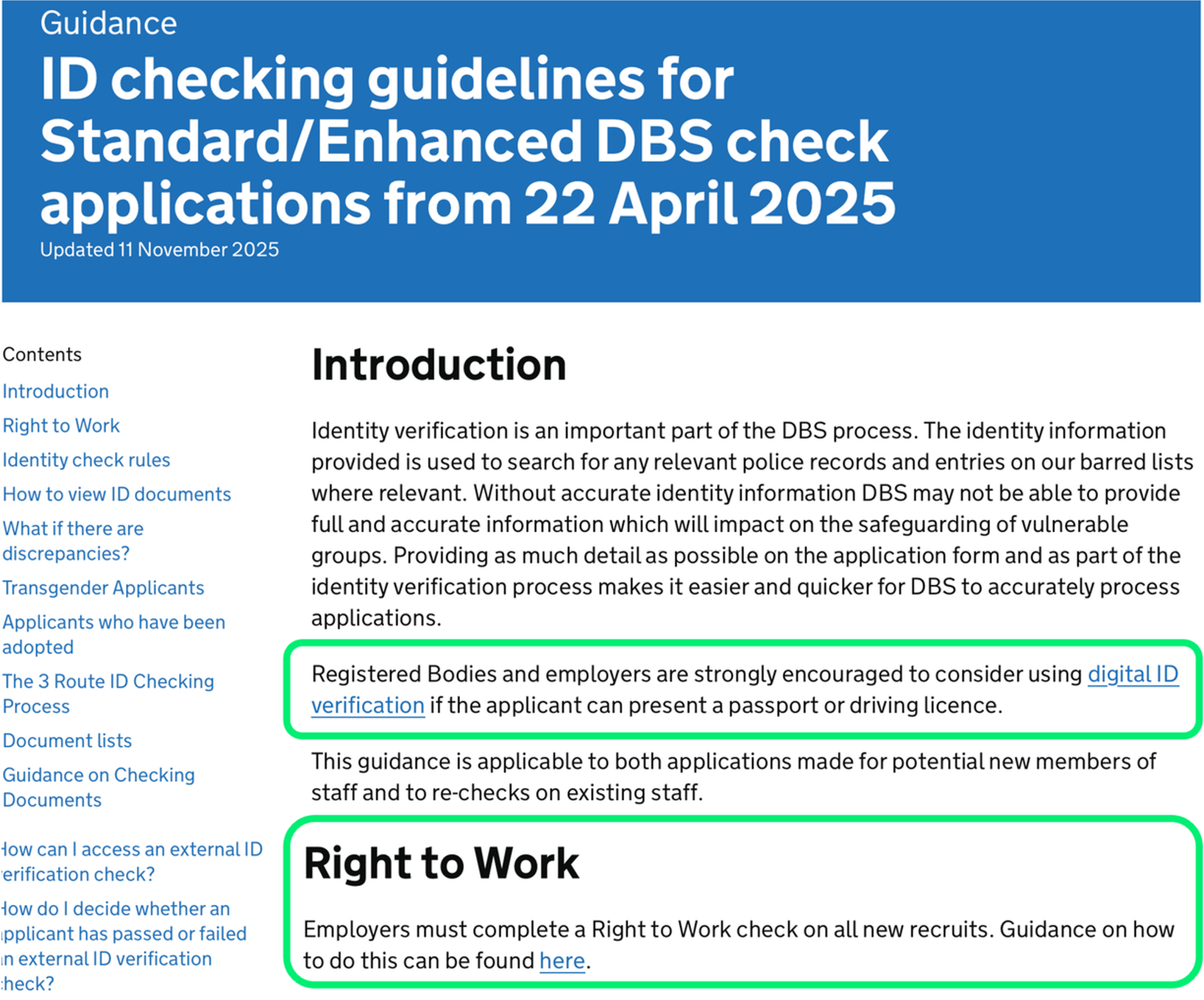
When we talk about the Level of Confidence in a DBS identity check, we mean the degree of assurance that an applicant’s identity has been correctly established and verified.
For employers, a higher level of confidence provides stronger assurance that the individual undergoing screening is who they claim to be.
The UK Government’s Good Practice Guide 45 (GPG45) establishes a framework for identity proofing and verification, with four confidence levels: Low, Medium, High, and Very High.
Under the current DBS digital identity verification guidance, the minimum confidence levels are:
- High confidence: Required for digital identity verification supporting Standard, Enhanced and Enhanced with Barred List(s) DBS checks.
- Medium confidence: Required for digital identity verification supporting Basic DBS checks.
Employers can choose to verify identities to a higher level of confidence where appropriate.
These requirements are particularly important for organisations in education, healthcare, social care, security, aviation, and other safeguarding-focused sectors.
DBS ID Verification Confidence Levels
GPG45 assesses the strength and reliability of identity evidence using five key components:
- Evidence strength: How difficult the document or identity evidence is to forge or counterfeit.
- Validity: Whether the evidence is genuine and valid.
- Activity history: Whether the claimed identity has an established history across relevant records.
- Identity fraud risk: Whether there are indicators suggesting the identity may have been compromised or used fraudulently.
- Verification: Whether the applicant can be reliably matched to the identity evidence.
These assessments combine to create an identity profile that demonstrates the level of confidence achieved.
For example, a biometric passport can provide stronger evidence than certain other identity documents because of its security features and the checks involved in issuing it.
This is why digital ID verification can offer significant advantages over relying solely on visual document inspection.

How to Automate DBS ID Verification for Safer Hiring
In 2024, our customers told us that DBS ID verification processes were often fragmented: part digital, part manual and frequently a poor candidate experience.
Employers were spending time collecting identity documents, checking information, managing separate screening processes and manually progressing DBS applications.
We set out to change that by developing DBS HI-ID, an automated workflow designed to bring identity verification and DBS application processing together.
Our objective was straightforward:
- DBS-compliant identity verification: Support the required level of identity confidence, including High confidence for Standard and Enhanced DBS applications.
- A fully automated candidate journey: Reduce manual administration and provide a smoother experience from identity capture to DBS submission.
- Stronger safeguarding processes: Help employers reduce identity fraud risks, improve consistency and maintain reliable verification evidence.
Rather than treating identity verification as a separate task, DBS HI-ID connects it directly to the wider DBS application process.
This new approach to ID verification automation means that once candidates have completed their required actions and the checks have passed, applications can progress without routine manual intervention.
Key Features of Our DBS Digital ID Check
EBC Global’s DBS HI-ID brings together several capabilities:
- Automated digital identity verification aligned with DBS requirements.
- Support for Basic, Standard, and Enhanced DBS applications.
- High-confidence identity verification, including H1A profiles where achieved.
- Biometric facial matching and document authentication.
- Combined Right to Work, address, and additional screening checks.
- Automated application completion, countersigning, and direct DBS submission.
- Centralised progress tracking and digital verification reports.
Unlike standalone ID verification software, DBS HI-ID connects identity verification to the actual DBS application workflow.
This means employers can reduce the need to move candidate information between separate systems, helping minimise duplicated work and avoidable errors.
Five Combined Checks in One Automated DBS Workflow
One of the biggest advantages of DBS HI-ID is that multiple checks can be completed through a single candidate journey.
Instead of asking candidates to complete separate processes for identity verification, Right to Work and DBS screening, HI-ID brings the relevant checks together.
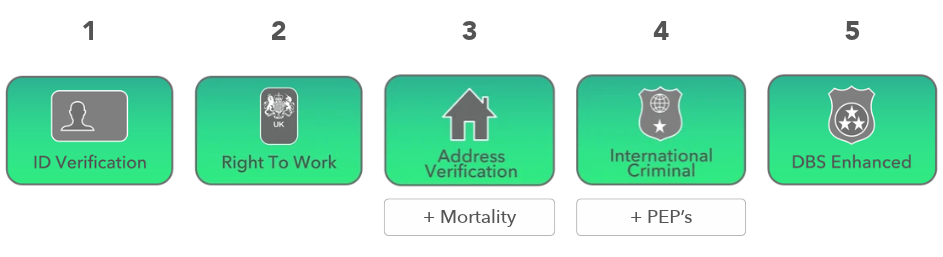
1. Digital ID Verification
The candidate captures an approved identity document and takes a live selfie.
HI-ID uses document authentication and biometric facial matching to assess whether the document is genuine and whether the candidate matches the identity evidence provided.
2. Right to Work Verification
Where applicable, the workflow confirms the candidate’s eligibility to work in the UK using the appropriate Right to Work verification method.
This helps employers manage Right to Work and DBS screening within a connected process, while retaining the separate evidence required for each check.
3. Address and Mortality Verification
Address verification compares candidate information against relevant trusted data sources, including electoral roll, HMRC and credit reference information where available.
Mortality checks provide an additional safeguard against the misuse of deceased individuals’ identities.
These checks contribute to a more complete assessment of the claimed identity.
4. International Sanctions and PEPs Screening
Standard and Enhanced DBS HI-ID workflows also screen against international sanctions lists and Politically Exposed Persons (PEPs) databases.
These additional checks can help identify information requiring further review.
Note: Basic DBS HI-ID excludes international sanctions screening. The checks included depend on the DBS workflow selected.
5. Automated DBS Application and Submission
Once the required verification steps have passed, the candidate’s information can be used to complete and progress the DBS application.
HI-ID automates the relevant submission and countersigning stages, allowing eligible applications to be sent directly to the DBS without routine manual intervention.
This is where automated DBS checks provide benefits beyond identity verification alone: the workflow connects candidate screening with the administrative stages required to submit an application.
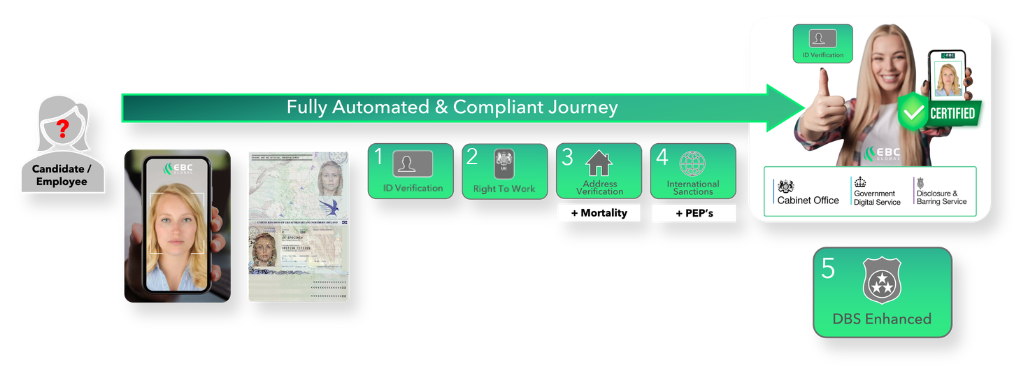
How EBC Global’s DBS HI-ID Works
Our process is designed to be fast, compliant and candidate-friendly.
Rather than requiring employers to manually coordinate each stage, HI-ID uses automated identity checks and connected workflows to progress applications.
1. One-click initiation
Employers initiate the DBS HI-ID process through EBC Global’s Employment Check Pro platform or API.
2. Candidate consent
The candidate receives a secure digital invitation and provides consent to begin the relevant verification checks.
3. Selfie and identity document capture
The candidate captures an approved identity document, typically a biometric passport, and takes a live selfie.
4. Automated identity verification checks
The system completes the applicable checks, including:
- Address verification through relevant trusted data sources.
- Mortality checks to identify potential identity misuse.
- Identity document authenticity and biometric matching.
- Right to Work verification using the appropriate route.
- International sanctions and PEPs screening where included.
5. Secure DBS data submission
Once the required checks have passed, HI-ID can automatically progress the application through the relevant completion, countersigning and submission stages.
Candidate information is securely submitted to the DBS for the applicable Basic, Standard or Enhanced check.
6. Real-time progress updates
Employers can track the application through the screening platform, providing visibility of progress and any actions that may require attention.
7. Digital verification report
Employers receive digital identity verification evidence, including a PDF report detailing the relevant checks and outcomes.
This report is separate from the official DBS certificate. View example final DBS HI-ID report here.
By connecting these stages, automated DBS checks help employers spend less time managing administrative tasks and more time focusing on recruitment and safeguarding decisions.

Faster DBS Processing and Less Manual Administration
One of the most significant challenges with traditional DBS screening is the time spent on administration before an application reaches the DBS.
Collecting documents, checking identity information, correcting errors, arranging countersigning and submitting applications can all introduce delays.
DBS HI-ID was designed to reduce these manual steps through automated, role-specific workflows.
This is particularly valuable for organisations managing large volumes of recruitment, including education, care, healthcare and security.
Reducing Average Processing Times
Automated workflows have helped reduce our average processing times compared with traditional Responsible Organisation (RO) and Registered Body (RB) vetting processes.

EBC Global’s automated DBS HI-ID workflow has reduced average processing times from 23 days with traditional RO/RB vetting to approximately 10 days. This comparison covers the wider screening journey, including the time associated with administrative processing, results and collection, rather than DBS processing time alone.
The improvement comes from removing unnecessary manual steps and third-party intervention, allowing applications to progress more efficiently.
How Quickly Are DBS Results Returned?
EBC Global’s reported processing figures also show that a significant proportion of DBS results are returned within 24 hours.
| DBS check type | Reported results within 24 hours |
|---|---|
| Basic DBS | 89% |
| Standard DBS | 78% |
| Enhanced DBS | 49% |
That means approximately 1 in 2 Enhanced DBS checks in the reported dataset were returned within 24 hours.
Actual turnaround times vary depending on the application, the information provided and any additional checks required by the DBS or relevant police forces. While automated workflows cannot guarantee how quickly the DBS completes every application, they can reduce delays associated with verification, administration, and submission.
For employers, that can mean faster onboarding, fewer outstanding applications and less time spent chasing screening progress.
Want to see how this works for your organisation? Explore EBC Global’s screening packages and trial options.
What Is the H1A Scoring System?
High Confidence (H1A) is a GPG45 identity profile that demonstrates a high level of assurance based on the strength and verification of the identity evidence provided.
It brings together assessments of document strength, validity, activity history, identity fraud risk, and verification.

For Standard and Enhanced DBS applications, achieving the required level of confidence is an important part of compliant digital identity verification.
EBC Global’s DBS HI-ID is designed to support high-confidence identity verification, including H1A where the necessary evidence and verification conditions are met.
For employers, this provides several benefits:
- Stronger assurance that candidates are who they claim to be.
- A consistent approach to identity verification.
- Reduced reliance on manual document inspection.
- Clear digital evidence of the checks completed.
- Fewer avoidable requests for additional information where the required identity profile has been achieved.
It is important to remember that a high-confidence identity result does not replace the criminal record check itself or remove the employer’s wider safeguarding responsibilities.
Problems with Manual DBS ID Checks
Although manual identity checking remains an accepted approach under DBS guidance, it can introduce operational challenges, particularly when recruitment volumes increase.
Some of the most common problems include:
- Inconsistency: Checks may depend on the knowledge and experience of individual employees.
- Delays: Missing documents, incomplete applications and repeated requests can slow down recruitment.
- Identity fraud: Counterfeit or altered documents may be difficult to identify through visual inspection alone.
- Compliance issues: Incorrect or incomplete verification can lead to applications being delayed or rejected.
- Administrative burden: Collecting, reviewing and securely storing sensitive identity documents requires time and careful data handling.
These challenges are one reason more employers are exploring automated identity verification as part of their recruitment processes.
Using automated identity checks can help standardise how evidence is collected, assessed, and recorded.
It also reduces the need for HR and recruitment teams to repeatedly request documents or manually transfer candidate information between systems.
For organisations managing multiple vacancies or sites, these improvements can make a substantial difference to day-to-day recruitment administration.
Why Our DBS ID Verification Is Top Tier
DBS HI-ID combines identity verification technology with automated DBS application processing, helping employers strengthen screening without adding unnecessary complexity for candidates.
The benefits go beyond simply verifying a passport or matching a selfie.
Trusted Data Sources
Identity information can be checked against relevant government, credit reference and other trusted data sources, supporting a more reliable assessment of the candidate’s identity.
Advanced Identity Verification Technology
Facial recognition, liveness detection and document authentication help assess whether identity evidence is genuine and belongs to the person presenting it.
Compliance-Focused Workflows
HI-ID is designed around applicable DBS identity verification requirements and the UK digital identity framework, helping employers follow a consistent process.
Digital Verification Evidence
Employers receive digital records of the relevant identity checks, providing evidence to support internal review and compliance processes.
Automated DBS Submission
Rather than stopping at identity verification, HI-ID connects the verified candidate information to the DBS application process.
This combination is what differentiates the workflow from general-purpose ID verification software.
Employers benefit from automated DBS checks that bring together identity proofing, additional screening and application administration in one connected journey.
The Future of DBS ID Verification
DBS identity verification guidance continues to evolve as digital technology becomes a more established part of recruitment screening.
The updated DBS identity checking guidelines introduced in April 2025, alongside subsequent updates, reinforce the importance of accurate identity information and appropriate verification processes.
The current guidance encourages Registered Bodies and employers to consider digital identity verification where suitable.
However, digital verification is not universally mandatory for every DBS application. Employers can continue to use permitted manual routes where the applicable guidance allows.
Several developments are shaping the future of identity verification:
- Greater adoption of digital verification: More organisations are using certified digital verification services to support identity checks.
- Stronger employer accountability: Registered Bodies and Responsible Organisations retain responsibilities for ensuring that identity verification and DBS applications meet the relevant requirements.
- More sophisticated fraud detection: Biometric matching, document authentication and automated fraud assessments can help identify suspicious evidence.
- Connected screening workflows: Employers increasingly benefit from systems that combine identity verification with other recruitment checks and application processing.
For employers considering how to automate ID verification, the objective should not simply be to replace a manual document check with a digital one.
The greater opportunity is to connect identity verification to the wider recruitment screening process, improving consistency, reducing repeated administration and maintaining reliable records.
EBC Global’s DBS HI-ID supports this approach by combining digital identity checks with automated DBS application workflows.
Access the Full Guidance
For more information about current DBS requirements and digital identity verification, see:
- DBS Digital Identity Verification Guidance – GOV.UK
- Good Practice Guide 45 – How to Prove and Verify Someone’s Identity
- DBS Standard Checks: Everything You Need to Know
- Enhanced DBS Checks: Everything You Need to Know
- Automating DBS Digital Identity Verification
- ID Verification Strategy for Employers
Get Your DBS ID Verification Right – Every Time
Whether you’re recruiting in education, healthcare, social care, security or another safeguarding-focused sector, reliable identity verification is an essential part of safer recruitment.
But achieving the right level of identity confidence shouldn’t mean creating more work for your HR and recruitment teams.
With EBC Global’s DBS HI-ID, you can:
- Verify candidate identities using automated digital verification technology.
- Support DBS-compliant identity checks with the appropriate confidence levels.
- Combine Right to Work, address verification and additional screening in one workflow.
- Reduce manual administration through automated application completion and submission.
- Access digital verification evidence and track application progress.
- Help candidates move through recruitment screening more efficiently.
Automated DBS checks are about more than speed. They’re about giving employers a consistent, reliable and efficient way to manage identity verification and DBS screening.
Start a free 12-day screening trial to explore how DBS HI-ID could simplify your recruitment process. Or, if you’d prefer to see the workflow in action, book a DBS HI-ID demonstration.
FAQs about Automated DBS Checks
Yes. DBS HI-ID can be initiated through EBC Global’s Pro platform or API, allowing employers to integrate automated identity verification and DBS checks into their existing recruitment workflows.
DBS HI-ID is also integrated with Eteach, enabling education recruiters to manage candidate screening and DBS checks directly within their recruitment process, reducing manual administration, and simplifying safer recruitment.
No. DBS guidance allows approved manual and digital identity verification methods. Digital verification must meet the relevant DBS requirements, including the appropriate identity confidence level.
Employers receive a digital PDF identity verification report detailing the checks completed and their outcomes. This provides evidence of the verification process and is separate from the official DBS certificate. You can view an example DBS HI-ID result here.
Employers are notified when verification cannot be completed successfully, with information about the outcome and next steps. Additional identity evidence or an alternative verification method may be required.
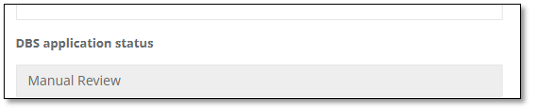
If a document is invalid, unsupported or fails verification, the application is flagged or stopped for manual review. The recruiter is automatically notified of any outstanding actions, ensuring incorrect identity information does not progress through the automated DBS process.
Yes. DBS HI-ID supports Right to Work verification using Home Office share codes where applicable, helping employers manage identity and eligibility checks within one connected workflow.
Yes. EBC Global’s DBS HI-ID supports Basic, Standard, and Enhanced DBS applications, with automated identity verification and screening workflows tailored to the relevant job type.
Automated DBS checks use software to streamline identity verification, candidate data collection, application validation, countersigning and submission. This reduces manual administration and helps employers process DBS applications more efficiently.


